
Manille card game rules
Manille is a trick-taking card game for four players in two teams, played with 32 cards. This page explains the Belgian and the French rules, which differ in the direction of play, the way trump is chosen and the way points are counted.
Android: coming soon
What is Manille?
Manille is a trick-taking card game for four players. You play in two teams of two, and partners sit across from each other. The pack has 32 cards, from the 7 up to the ace, and every player gets 8. In a trick-taking game each player plays one card in turn, and the four cards played in one round are a trick. The highest card of the suit that was led takes the trick, unless a trump is played. A team collects tricks and counts the points on the cards in them.
The rules of Manille differ from country to country. The Belgian game lets the dealer choose trump and allows doubling, while the French game turns up a card to name the trump and counts the points another way. Both are explained below, and the table further down puts them side by side.
The cards and what they are worth
In every suit the ten is the highest card, and it is called the manille. After it come the ace, king, queen, jack, 9, 8 and 7. Only the ten (5 points), the ace (4), the king (3), the queen (2) and the jack (1) are worth points, and the 9, 8 and 7 are worth nothing. That makes 60 points in the whole pack, so under the Belgian rules 30 is exactly half.
| Order, highest first | Card | Points |
|---|---|---|
| 1 | Ten, the manille | 5 |
| 2 | Ace | 4 |
| 3 | King | 3 |
| 4 | Queen | 2 |
| 5 | Jack | 1 |
| 6, 7, 8 | 9, 8, 7 | 0 |
How a trick works
- The first card of the trick sets the suit. If you have that suit, you must follow it, which means playing a card of the same suit as the one that was led.
- The highest card of the suit that was led takes the trick. If somebody plays a trump, the highest trump takes it instead.
- When your opponents hold the trick, you must take it if you can: with a higher card of the suit that was led or, if you have none of that suit, with a trump. You may not then play a lower trump than the one already on the table, unless all the cards in your hand are trumps.
- When your partner holds the trick, it is enough to follow suit. If you have none of that suit, you may play any card.
These rules are the same under the Belgian and the French rules.
Belgian rules, step by step
- The cards are dealt in packets of 3, 3 and 2, so that everyone has 8. The player to the left of the dealer leads the first trick, and the game goes clockwise.
- The dealer chooses the trump suit, or plays without trump. Without trump the hand counts double.
- Once trump is chosen, the dealer's opponents may double the points, and then the dealer's team may double again. The points never count more than four times.
- Play the eight tricks.
- Each team counts the points of the cards in its tricks. The team with more than 30 points writes down the points above 30, multiplied by how many times the hand counts. For example, 38 points in a hand that counts once write 8.
- When both teams have exactly 30, it is a plat: nobody scores and the next hand counts double.
- The first team to reach 101 points wins the match.
In the app's settings you can also switch on a house rule for the Belgian game: a team that takes every trick writes 60 instead of 30. It is off by default.
French rules, step by step
- The cards are dealt in two packets of 4. Nobody chooses trump: the last card the dealer receives is turned up, and its suit is trump. If that card is worth points, the dealer's team writes them down at once.
- The game goes counter-clockwise, and the player to the right of the dealer leads the first trick.
- Each team counts the points of the cards in its tricks and one point for every trick. The team with more points writes down the points above 34, and the other team writes nothing. Nothing is multiplied and nobody doubles.
- When both teams have exactly 34, nobody scores.
- A set is played to 34 points, and the first team to win two sets wins the match. If each team has won one set, a deciding third set goes to 44 points.
Belgian and French rules side by side
| Belgian rules | French rules | |
|---|---|---|
| Direction of play | Clockwise | Counter-clockwise |
| First trick led by | The player to the left of the dealer | The player to the right of the dealer |
| Dealing | Packets of 3, 3 and 2 | Two packets of 4 |
| Trump | The dealer chooses, or plays without trump | The last card the dealer receives, turned up |
| Doubling | Yes, and the hand never counts more than four times | No |
| Counting | Points above 30, times how often the hand counts | Card points plus one per trick, above 34 |
| End of the match | First team to 101 points | Two sets won, with a deciding third set to 44 |
Which rules should you play?
Play the rules your table knows. If you learned Manille in Belgium, the Belgian rules will feel familiar, and the French rules are the ones to choose if you learned it in France. Mixing them is how arguments start, so agree before the first card is dealt.
Manille on your phone
Manille Card Game is our Android app for this game. You and your partner play against two opponents, and your partner and both opponents are bots. The first time you start it, the app asks which rules you play, and you can change them later in the settings for your next game. A phone set to Belgium is offered the Belgian rules and a phone set to France the French rules. On a phone set to any other region you choose yourself.
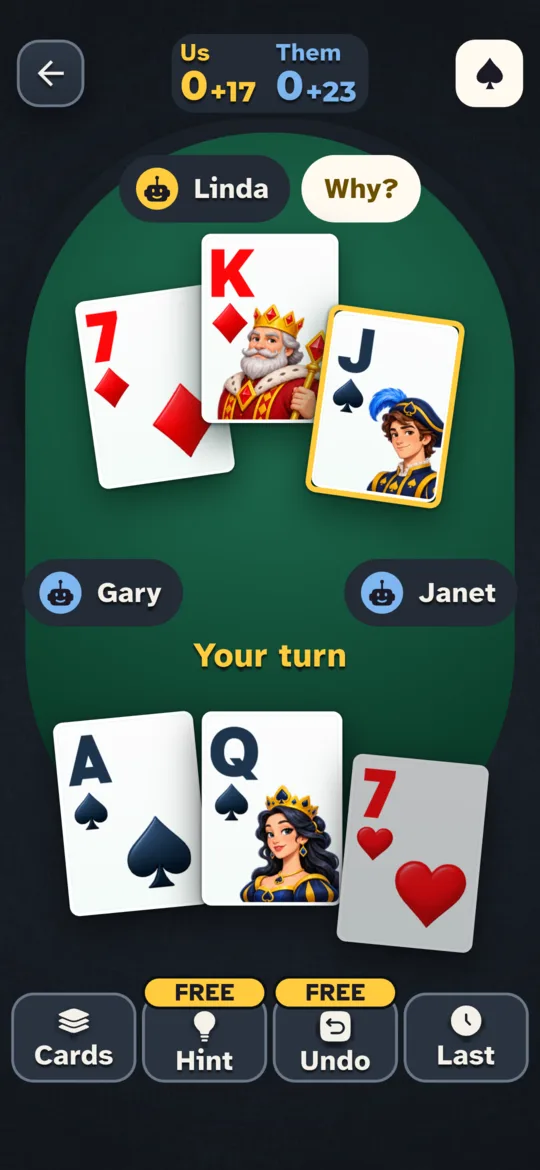
The table, with your hand and the score of both teams. 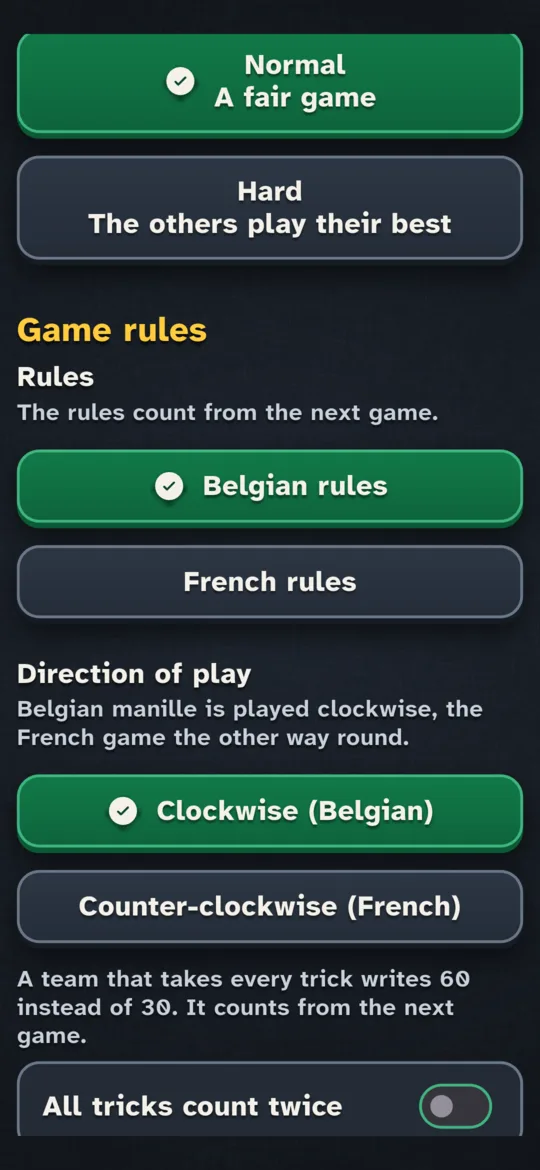
Choosing Belgian or French rules. 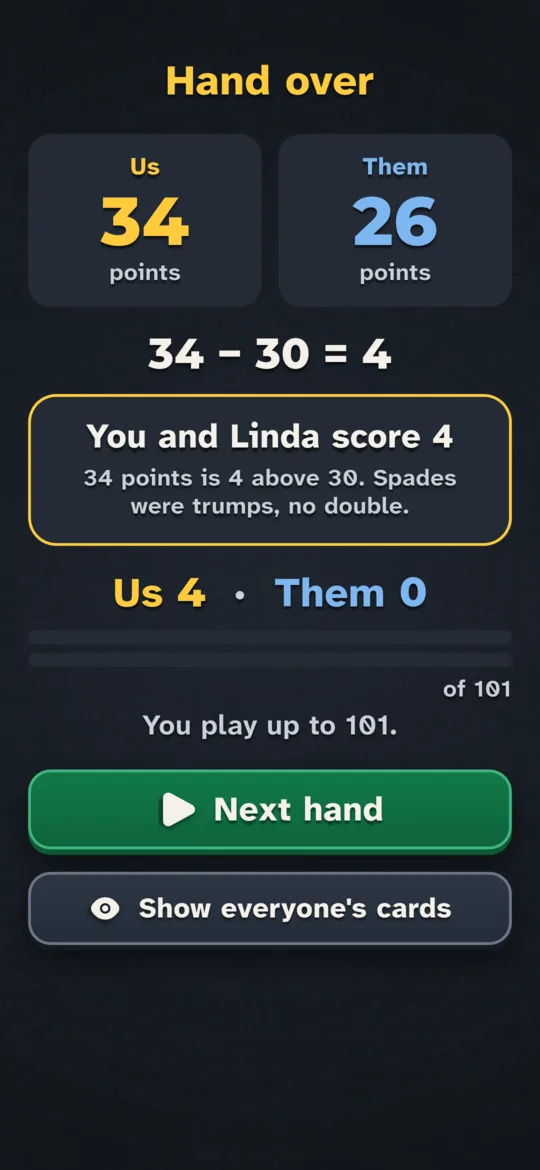
Every score explained, here under the Belgian rules: 34 minus 30 leaves 4.
If you are new to Manille, the tutorial walks you through your first hand and explains each rule at the moment it matters for your move. A card that breaks the rules is refused, and the game tells you why. When you are unsure, ask for a hint or undo a move, and look at the last trick to see what was played. Hints and undos come in a limited supply, and watching a video adds more. After your partner has played, tap Why? to read in one sentence why they chose that card. At the end of each hand the game shows how the points were counted, step by step. The cards are big and clear.
How the app handles data is described in the privacy policy.